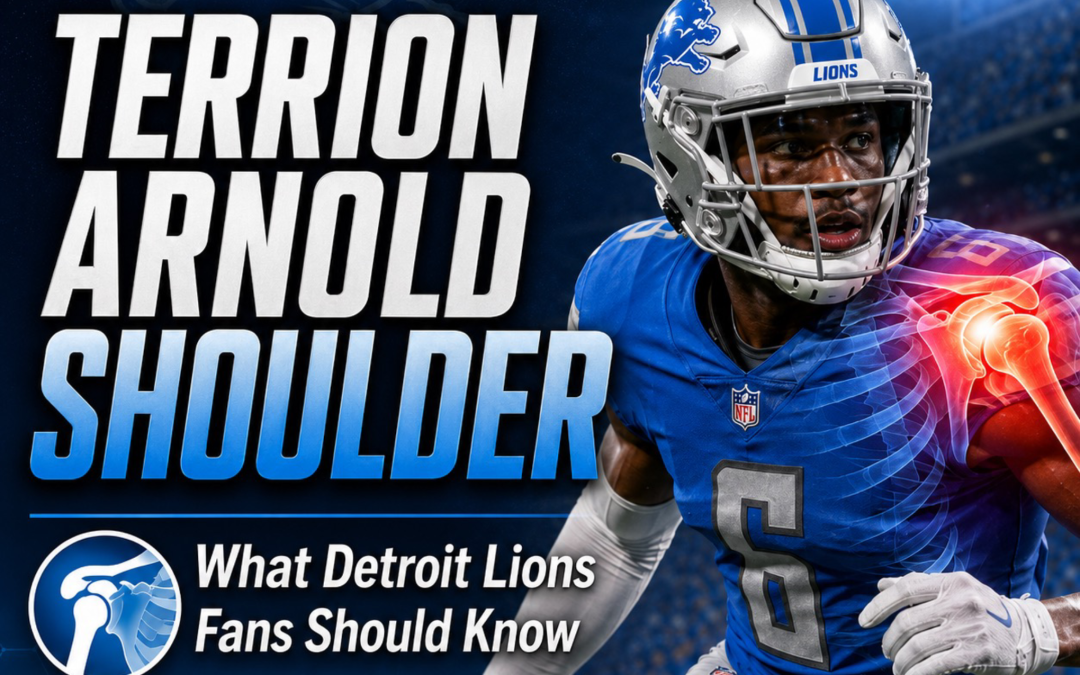
Detroit Lions cornerback Terrion Arnold has quickly become one of the most talked-about young defensive backs in Detroit. A first-round pick out of Alabama, Arnold brings speed, confidence, physicality, and the type of competitive energy Lions fans love to see on Sundays. But like many football players, his development has also been shaped by the physical demands of the game.
In a recent Woodward Sports segment, Dr. Jeff S. Pierce of Michigan Sports & Spine Center reacted to Arnold’s shoulder injury and helped explain why shoulder injuries in football can be more complicated than they look from the stands.
Arnold’s shoulder injury became a major storyline because it showed how demanding football can be on the body, especially for players who rely on physical coverage, tackling, speed, and upper-body strength. For fans, athletes, parents, and weekend warriors, Arnold’s situation is a reminder of one major truth: the shoulder is one of the most mobile joints in the body, but that mobility also makes it vulnerable to injury.
Why Shoulder Injuries Are So Common in Football
Football is a collision sport. Every tackle, block, fall, and awkward landing can place stress on the shoulder joint. Defensive backs like Arnold are especially exposed because they must tackle in space, fight through contact, extend their arms, and land hard while moving at high speed.
The shoulder is built for motion. It allows the arm to rotate, reach, lift, push, pull, and absorb impact. But because it has so much range of motion, it relies heavily on surrounding muscles, tendons, ligaments, and cartilage for stability.
That is why shoulder injuries in football are not always as simple as “pain” or “soreness.” An athlete may be dealing with instability, inflammation, soft tissue damage, labral injury, rotator cuff irritation, or a combination of issues.
What Could a Football Shoulder Injury Involve?
Without examining Arnold personally, no one outside his medical team can diagnose the exact nature of his injury. However, football-related shoulder injuries often involve conditions such as:
Shoulder instability
This happens when the shoulder feels loose, slips, or partially comes out of place. Instability can make tackling, reaching, or absorbing contact difficult.
Labral injuries
The labrum helps deepen and stabilize the shoulder socket. A labral injury can cause pain, weakness, clicking, catching, or a feeling that the shoulder is unstable.
Rotator cuff irritation or injury
The rotator cuff helps control and stabilize shoulder movement. Football players can irritate or strain these tissues through contact, falls, repetitive use, or awkward arm positioning.
AC joint injuries
The AC joint is located near the top of the shoulder. It is commonly injured when an athlete lands directly on the shoulder.
Shoulder separation or subluxation
A subluxation means the shoulder partially slips out of place. Even if it goes back in quickly, it can still damage surrounding tissues and create long-term instability.
Michigan Sports & Spine Center treats many shoulder-related problems, including rotator cuff injuries, glenoid labrum injuries, shoulder instability, shoulder separation, subluxation, bursitis, tendonitis, and impingement.
Why Returning Too Soon Can Be Risky
One of the biggest challenges in sports medicine is deciding when an athlete is truly ready to return. Pain is only one part of the picture. A player may feel better but still lack full strength, stability, range of motion, or confidence in the injured shoulder.
For a cornerback, that matters. A defensive back needs to jam receivers, extend for pass breakups, wrap up ball carriers, and hit the ground repeatedly. If the shoulder is unstable or weak, the risk of reinjury can increase.
That is why return-to-play decisions often involve more than a simple timeline. Doctors and rehab specialists may evaluate:
Range of motion
Strength compared to the uninjured side
Pain level during football-specific movement
Shoulder stability
Ability to absorb contact
Functional testing
Imaging results when needed
Position-specific demands
A successful return from shoulder surgery or a serious shoulder injury is not just about healing tissue. It is about restoring trust in the shoulder. Athletes have to believe they can hit, land, reach, and react without hesitation.
What Lions Fans Should Watch During Arnold’s Return
As Arnold works his way back, the key question will not just be whether he is practicing. It will be how confidently he moves.
Fans should watch for:
How he tackles in contact drills
Whether he wears additional shoulder support
How he uses his arms in press coverage
Whether he appears limited in range of motion
How often he participates in full-team periods
Whether the Lions manage his workload early
For athletes at every level, this is an important reminder that returning to play should be based on strength, stability, mobility, and proper medical guidance — not just toughness.
The Bigger Lesson: Shoulder Pain Should Not Be Ignored
You do not have to be an NFL player to deal with shoulder pain. Many people experience shoulder problems from work injuries, car accidents, lifting, exercise, home projects, sports, or repetitive daily movement.
Common warning signs include:
Pain when lifting the arm
Shoulder weakness
Clicking, catching, or popping
Pain at night
Loss of range of motion
Numbness or tingling
A feeling that the shoulder may slip out of place
Pain after a fall, collision, or sudden pull
If shoulder pain lingers, gets worse, or limits your normal activities, it is worth getting evaluated. Early diagnosis can help prevent a small problem from becoming a long-term issue.
Shoulder Pain? Get Expert Care at Michigan Sports & Spine Center
If you are dealing with shoulder pain, weakness, stiffness, instability, or discomfort after a sports injury, car accident, work injury, or everyday activity, do not wait for the problem to get worse.
At Michigan Sports & Spine Center, our team helps patients identify the source of shoulder pain and create a personalized treatment plan focused on recovery, mobility, and long-term function. Whether you are an athlete trying to return to competition or someone who simply wants to lift, reach, sleep, work, and move without pain, MSSC offers advanced care options designed around your needs.
Our services may include:
Comprehensive injury evaluations
Physical therapy and rehabilitation
Non-surgical shoulder pain treatment
Regenerative medicine options
Image-guided injections
Sports injury care
Work and auto injury treatment
Personalized recovery planning
Shoulder injuries can affect more than your game. They can affect your daily life. Getting the right diagnosis and treatment early can help reduce pain, restore strength, and prevent the injury from becoming a long-term problem.
Do not ignore shoulder pain. Schedule an appointment with Michigan Sports & Spine Center today.
Call (248) 426-9944 or visit MichiganSportsAndSpine.com to learn more about treatment options and start your recovery.
How Michigan Sports & Spine Center Helps Patients Recover
Michigan Sports & Spine Center focuses on comprehensive care through Physical Medicine, Rehabilitation, and Regenerative Medicine, with an emphasis on helping patients improve function, recover from injury, and prevent future problems.
MSSC offers services that can support shoulder injury evaluation and recovery, including comprehensive exams, imaging, injections, regenerative medicine, physical therapy, osteopathic manipulation, EMG testing, and musculoskeletal ultrasound.
That approach matters because shoulder injuries often require more than a quick fix. A proper recovery plan may include accurate diagnosis, inflammation control, mobility work, strengthening, posture correction, manual therapy, and a safe progression back to activity.
For athletes, that may mean returning to the field. For everyday patients, it may mean getting back to work, exercise, sleep, driving, lifting, or simply living without constant shoulder pain.
Final Takeaway
Terrion Arnold’s shoulder injury is a major storyline for Detroit Lions fans, but it is also a useful reminder: shoulder injuries deserve serious attention.
Whether you are an NFL cornerback, a high school athlete, a weekend golfer, a gym-goer, or someone dealing with everyday shoulder pain, the goal is the same — restore movement, rebuild strength, reduce pain, and prevent the injury from coming back.
Get back in the game of life.
If shoulder pain is limiting your movement, performance, sleep, or daily routine, Michigan Sports & Spine Center can help you take the next step toward recovery.
Call (248) 426-9944 or visit MichiganSportsAndSpine.com to schedule a consultation today.